
Daily Stretching Routine for Beginners

You do not need a gym membership, special equipment, or an hour of free time to take better care of your body. A handful of simple stretching exercises, done for 10 to 15 minutes each day, can loosen tight muscles, ease joint stiffness, and lower your risk of common injuries.
At OPA Ortho, our board-certified orthopedic surgeons and sports medicine physicians treat thousands of muscle, bone, and joint injuries every year. One pattern we see over and over is preventable strains and stiffness in patients who have stopped moving their bodies through a full range of motion. A daily stretching routine is one of the easiest ways to break that cycle.
Whether you sit at a desk all day, stay on your feet for work, or just want to move with less discomfort, this guide walks you through a complete full-body stretching routine you can follow at home, starting today.
Why Stretching Every Day Matters
Stretching on a regular basis does more than help you touch your toes. Here are the key benefits of stretching daily:
- Improved flexibility: Muscles that get stretched regularly stay longer and more pliable, which keeps your joints moving through their full range of motion.
- Less muscle tension: Tight muscles pull on your joints and create aches in your neck, shoulders, hips, and lower back. Stretching releases that built-up tension.
- Better circulation: Stretching sends more blood flow to your muscles and soft tissues, which supports healing and keeps you feeling energized.
- Injury prevention: Flexible muscles absorb force better during physical activity. That means fewer strains, sprains, and overuse injuries over time.
- Reduced stiffness as you age: Joint stiffness builds slowly over years of limited movement. A daily habit helps you stay mobile and independent longer.
Best Time to Stretch
You can stretch at any point in the day and still benefit. That said, timing matters a little depending on your goals.
If you stretch first thing in the morning, keep the movements gentle. Your muscles have been inactive for hours, so ease into each position slowly. A morning stretching routine is a great way to wake up your body and reduce overnight stiffness.
If you prefer to stretch after a workout or at the end of the day, your muscles will already be warm. That makes it easier to go a bit deeper into each stretch safely. According to the Mayo Clinic stretching guidelines, warming up for five minutes before you stretch helps reduce your risk of pulling a muscle.
The bottom line is, pick whatever time fits your schedule and stick with it. Consistency matters more than timing.
Tips Before You Start
These tips will help you get the most from your stretching exercises as a beginner and avoid setbacks.
- Warm up first. Walk around for a few minutes or march in place. Cold muscles do not stretch well and are easier to injure.
- Breathe steadily. Inhale before a stretch, then exhale as you ease into it. Never hold your breath.
- Hold, do not bounce. Keep each stretch still for 15 to 30 seconds. Bouncing can tear muscle fibers.
- Stop if it hurts. Stretching should feel like a gentle pull, not pain. If something feels sharp or stabbing, back off right away.
- Stay consistent. Short sessions every day beat one long session once a week. Build the habit, and your body will respond.
Full-Body Daily Stretching Routine for Beginners
These stretching exercises at home target every major muscle group from head to toe. You do not need any equipment. A yoga mat is helpful but not required.
Neck and Shoulders
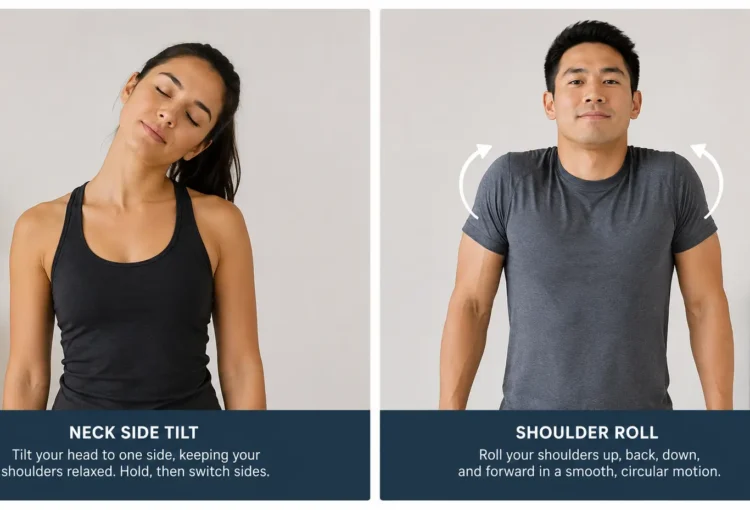
Neck Side Tilt: Stand or sit tall. Slowly tilt your right ear toward your right shoulder until you feel a gentle pull on the left side of your neck. Hold for 20 seconds, then switch sides. Repeat twice per side.
Shoulder Roll: Roll both shoulders forward in a smooth circle five times, then reverse direction for five more. This releases tension that builds from sitting or looking at screens.
Upper Back and Chest
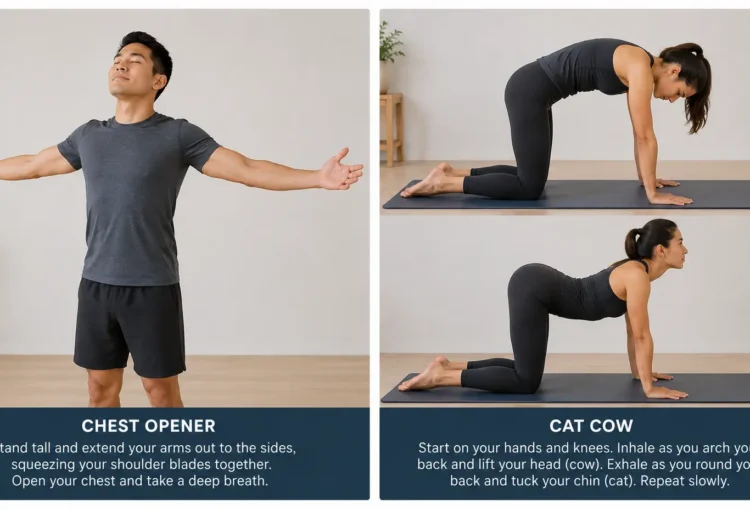
Chest Opener: Stand in an open doorway. Place your forearms on either side of the door frame at shoulder height. Step one foot forward and lean gently until you feel a stretch across your chest. Hold for 20 seconds.
Cat-Cow: Get on your hands and knees. Arch your back toward the ceiling like a cat (round your spine), hold two seconds, then drop your belly toward the floor and lift your head (cow position). Repeat five to eight times slowly.
Hips and Hamstrings
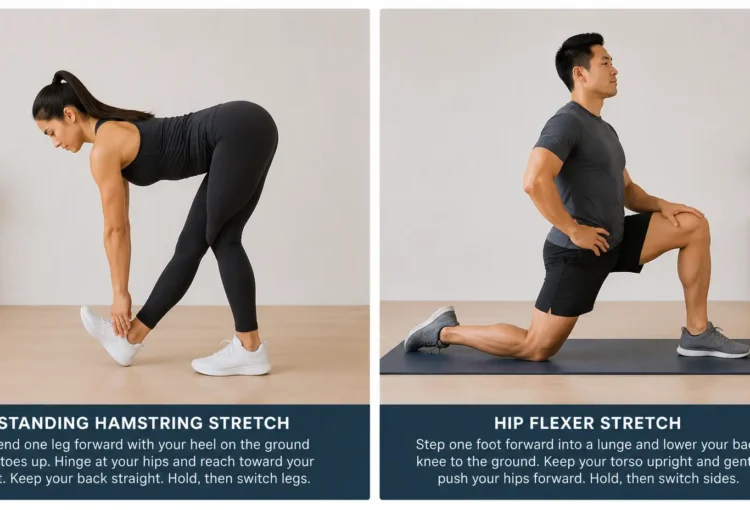
Standing Hamstring Stretch: Place one heel on a low step or the floor in front of you with your toes pointing up. Keep that leg straight and hinge forward at the hips until you feel a pull behind your thigh. Hold for 20 seconds per side.
Hip Flexor Stretch: Kneel on your right knee with your left foot flat in front of you (like a lunge). Shift your weight forward until you feel a stretch in the front of your right hip. Hold for 20 seconds, then switch. This is especially helpful if you sit for long periods.
Quads and Calves
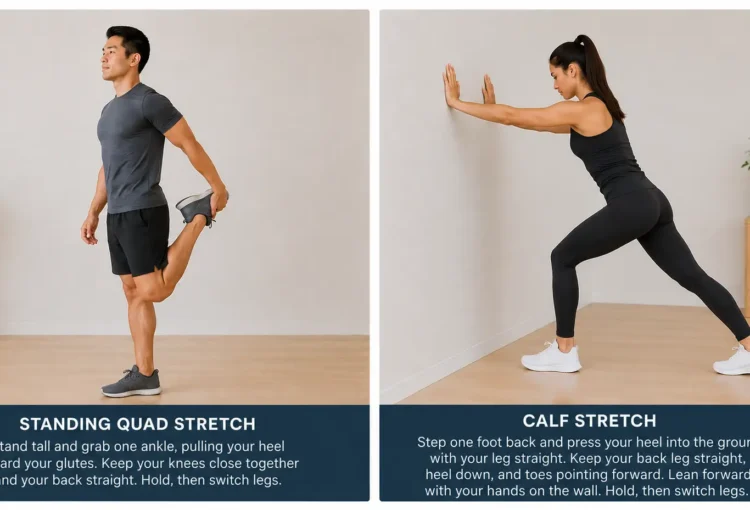
Standing Quad Stretch: Hold onto a wall or chair for balance. Bend your right knee and grab your right foot behind you. Pull your heel gently toward your glutes. Keep your knees close together. Hold for 20 seconds per side.
Calf Stretch: Face a wall and step your right foot back about two feet. Press your right heel into the floor while bending your left knee forward. You should feel the stretch in your right calf. Hold for 20 seconds per side.
Sample 10 to 15 Minute Full Body Stretching Routine
Follow this table to complete your daily session. Do each stretch in order, and you will cover your entire body in about 12 minutes.
| Exercise | Hold Time | Reps/Side | Target Area |
| Neck Side Tilt | 20 seconds | 2 per side | Neck |
| Shoulder Roll | N/A | 5 each direction | Shoulders |
| Chest Opener | 20 seconds | 2 | Chest, front shoulders |
| Cat-Cow | 2 sec each | 5-8 cycles | Upper back, spine |
| Standing Hamstring Stretch | 20 seconds | 2 per side | Hamstrings |
| Hip Flexor Stretch | 20 seconds | 2 per side | Hip flexors |
| Standing Quad Stretch | 20 seconds | 2 per side | Quadriceps |
| Calf Stretch | 20 seconds | 2 per side | Calves |
Common Mistakes to Avoid when Doing Stretching Exercises
- Bouncing into a stretch. This triggers your muscles to tighten up instead of relax. Always hold each position still.
- Stretching cold muscles. Skipping the warm-up makes strains more likely. Even a two-minute walk helps.
- Holding your breath. Steady breathing helps your muscles release. Holding your breath creates extra tension.
- Pushing through pain. A mild pull is normal. Sharp or shooting pain means you have gone too far. Ease back.
- Rushing the routine. Speeding through your stretches reduces the benefit. Give each position its full 15 to 30 seconds.
- Only stretching one area. Your body works as a connected chain. Tight calves can affect your knees, hips, and lower back. Cover every major group.
How Long Before You See Results
Most beginners notice improved flexibility within two to four weeks of consistent daily stretching. You may feel less stiff after just a few sessions, but real changes in your range of motion take time.
Stick with it for at least four to six weeks before judging your progress. Flexibility builds gradually. The people who see the biggest improvements are the ones who do their stretching exercises a little bit every single day rather than cramming one long session once in a while.
Who Should Avoid Certain Stretches
Stretching is safe for most people, but certain conditions call for extra caution. Talk to your doctor or an orthopedic specialist before starting a stretching routine if any of the following apply to you:
- Recent joint surgery or replacement: Your surgeon or physical therapist should clear you before you stretch the affected area.
- Acute injuries: A fresh muscle tear, fracture, or sprain needs rest, not stretching. Wait until a provider says it is safe.
- Osteoporosis: Some forward-bending stretches can increase the risk of spinal compression fractures. Ask your doctor which movements to avoid.
- Hypermobility disorders: If your joints already move beyond a normal range, overstretching can cause instability and pain. Focus on strengthening instead.
- Severe or worsening pain: Pain that does not improve or gets worse with gentle movement is a signal to see a specialist. Do not stretch through it.
If you are recovering from surgery, our guide to post-surgery rehabilitation exercises covers safe ways to rebuild flexibility under professional guidance.
Start Your Routine Today
Building a daily habit around simple stretching exercises is one of the smartest things you can do to protect your muscles, joints, and long-term mobility. You just need to start becoming flexible.
For a deeper look at how stretching supports your musculoskeletal health, visit our guide on the importance of stretching and flexibility. And if stiffness or pain is holding you back from moving comfortably, our orthopedic team can help you find the right path forward.